Wildfire Resilience Efforts, Where are we now.
Wildfire Resilience Efforts in Southern California

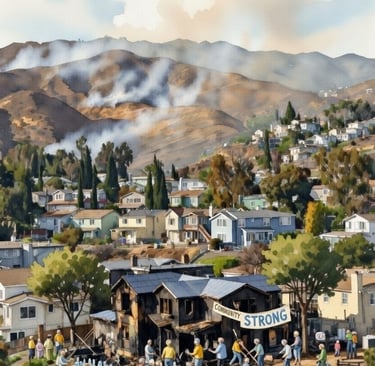
Wildfire Resilience Efforts in Southern California
Southern California communities, particularly in areas like Los Angeles County, Malibu, Altadena, and the Santa Monica Mountains, have been actively working to build resilience against wildfires through a combination of government-led initiatives, community partnerships, and innovative strategies. These efforts have intensified following major events like the 2024 Airport and Line Fires, and the devastating 2025 Eaton and Palisades Firestorms, which caused widespread destruction and highlighted vulnerabilities. Stories from these communities emphasize recovery planning, infrastructure hardening, ignition prevention, and inclusive evacuation systems, often involving collaboration between state agencies, non-profits, tribes, and residents. Below, I'll highlight key stories and initiatives drawn from recent reports and programs.
Recovery and Rebuilding After the 2025 Los Angeles Firestorms
In the wake of the 2025 firestorms that scorched Los Angeles County, killing 29 people, destroying 18,000 homes, and causing over $50 billion in damages, communities like Altadena and Malibu have focused on rebuilding with resilience in mind. The Governor’s Office of Land Use and Climate Innovation (LCI) partnered with the California Governor’s Office of Emergency Services (Cal OES) and FEMA to conduct a Recovery Needs Assessment (RNA) shortly after the fires. This assessment identified gaps in housing, infrastructure, and community stability, leading to a Recovery Support Strategy (RSS) that connected needs with funding and partners. For instance, in Malibu, the RNA informed a City Council-led strategic planning process emphasizing economic recovery, wildland fire management, and post-wildfire watershed restoration. Challenges included displaced families and overwhelmed local governments, but outcomes featured streamlined permitting via executive orders, fast-tracked construction, and monthly recovery meetings for ongoing technical assistance. Deputy City Manager Richard Rojas noted that these efforts better prepared Malibu for collaboration with regional partners, turning crisis into long-term stability.
In resource-constrained neighborhoods like west Altadena—where all 17 Eaton Fire deaths occurred due to delayed evacuation alerts—recovery has spotlighted inequities. Black and low-income households faced disproportionate destruction and slower aid, with insurance non-renewals forcing reliance on state programs like the FAIR plan. UCLA's Institute of Transportation Studies recommends strategies like rapid infrastructure repairs and private sector involvement (e.g., Airbnb's free housing for evacuees) to ensure fair resource distribution.
Community Hardening and Ignition Reduction Initiatives
Southern California's chaparral landscapes, prone to fast-spreading fires during Santa Ana winds, have seen extensive hardening efforts. The Wildfire Task Force reports that since 2021, over 500 resilience projects have been completed statewide, including 129 in Los Angeles County. Key examples include:
- Structure Hardening: CAL FIRE inspected over 216,000 homes in 2023/24, focusing on "Zone Zero" regulations (clearing within 5 feet of structures) per Governor Newsom's executive order. The California Wildfire Mitigation Program retrofits homes in high-risk, socially vulnerable areas, creating defensible space to reduce flame risks.
- Ignition Reduction: The Southern California Ignition Reduction Program, involving USFS, Caltrans, and CAL FIRE, treated 134,000 acres along roadsides and 29,800 acres via fuels reduction projects. Community actions, like mowing grass early and vehicle maintenance, complement these to prevent human-caused ignitions (which account for 100% during high winds).
- Strategic Fuel Breaks: USFS treated 50,000+ acres since 2023, with breaks protecting Lake Elsinore from the 2024 Airport Fire and Angelus Oaks from the Line Fire. The Bureau of Land Management's cross-boundary breaks contained the 2024 Grove 2 Fire in San Diego County.
A personal story from Jefferson Park illustrates grassroots resilience: After a house fire destroyed their historic home, residents Miguel and Melanie rebuilt with community support, sharing their emotional journey to inspire others amid broader wildfire recovery.
Inclusive Evacuation and Long-Term Transportation Resilience
Drawing from fires like the 2018 Camp Fire and 2025 Eaton Fire, where communication failures delayed evacuations, UCLA outlines inclusive systems for vulnerable groups (e.g., low-income, elderly, disabled). Strategies include bus-based evacuations with pre-registration, solar-powered alerts, and community liaisons using low-tech tools. For long-term resilience, multimodal redundancy—like helicopter pads and shuttle services—aims to prevent stranding. In Altadena, erroneous alerts eroded trust, disproportionately affecting minorities, who are 50% more disaster-prone.
State Parks and Tribal Partnerships
California State Parks' 2021 Wildfire and Forest Resilience Program funds prescribed burns and ecosystem stewardship, incorporating tribal knowledge. In Southern California, teams protected sites during the Palisades Fire by collaborating with the Chumash Fire Department and tribes. Sarah Gibson, statewide burn boss, hosts cultural burning trainings with eight tribes, supported by Parks California stipends. Burns at places like Harmony Headlands regenerate habitats, while visitors are urged to report smoke early.
Utility and Microgrid Innovations
Utilities like Southern California Edison (SCE) are hardening grids, undergrounding lines, and installing cameras to mitigate risks.
Microgrids, as in Blue Lake Rancheria or Menifee developments, provide backup power during high-risk periods, reducing outage impacts.
The Menifee development (in Riverside County) showcases a residential-scale microgrid in the Shadow Mountain community by KB Home and SunPower, believed to be California's first of its kind. This all-electric neighborhood features over 200 net-zero-ready homes, each with individual solar panels and home battery storage, connected to a shared 2 MW community battery. During grid outages—common in wildfire-prone areas—the microgrid allows homes to draw from their own batteries and the centralized one, keeping lights, appliances (like HVAC, water heaters, and select loads), and essential functions running seamlessly. Residents often remain unaware of outages, as the system maintains power without relying on the main grid, serving as a model for future wildfire-resilient suburban developments by minimizing disruption, enhancing safety, and integrating renewables for long-term reliability.
| Initiative | Key Communities Involved | Resilience Measures | Outcomes/Examples |
| Recovery Needs Assessment (RNA) | Malibu, Altadena | Safer housing, infrastructure upgrades, watershed recovery | Streamlined rebuilding, better partner coordination post-2025 fires |
| Ignition Reduction Program | Los Angeles County, San Diego | Roadside treatments, powerline hardening | 134,000+ acres treated, prevented ignitions during winds |
| Inclusive Evacuation Systems | Vulnerable LA neighborhoods | Bus networks, multilingual alerts, community liaisons | Reduced delays for low-income groups, as tested in 2018 Camp Fire |
| State Parks Resilience Program | Santa Monica Mountains, Topanga | Prescribed burns, tribal cultural burning | Protected cultural sites during Palisades Fire, habitat regeneration |
These stories show a multi-faceted approach, blending immediate recovery with proactive prevention, though challenges like inequities persist.
Many Southern California communities, despite some progress in hardening homes, creating defensible space, and implementing recovery plans after events like the 2025 Eaton and Palisades fires, have been criticized for not doing enough to address the escalating threat of fast-moving wildfires—often referred to as "fast fires"—which spread rapidly under high winds and dry conditions, disproportionately causing loss of life, property destruction, and massive suppression costs. Critics point to insufficient investment in proactive measures such as widespread fuels reduction, updated building codes in vulnerable areas, reliable infrastructure like functional reservoirs during crises, and comprehensive community education on fire history and neighborly preparedness, leaving gaps that exacerbate inequities and repeat vulnerabilities year after year. As a strong starting point to bridge these shortcomings, the Fast Fire Network offers a promising pathway forward by uniting fire scientists, data experts, practitioners, and industry partners to develop a new fast fire risk framework that integrates fire speed, human exposure, social/structural vulnerability, and actionable tools like open data platforms, AI-enabled solutions, and stakeholder forums. Engaging with or contributing to the Fast Fire Network can help communities access data-driven strategies, collaborative innovations, and co-produced science tailored to reducing risks from these high-velocity blazes, ultimately empowering local leaders, residents, and agencies to build more proactive, inclusive resilience before the next fast fire strikes.
Official Government and State Recovery Resources for this article:
- Governor's Office of California – One Year After Los Angeles Firestorms (January 2025 update on all-of-government recovery efforts, including prepositioned resources, rebuilding acceleration, and calls for federal aid):
- Governor’s Office of Land Use and Climate Innovation (LCI) – From Crisis to Recovery (Details on helping communities rebuild stronger post-2025 fires):
https://lci.ca.gov/news/2026/01-07.html
- Los Angeles County – One Year Later: Recovery, Resilience and Lessons Learned (Milestones in rebuilding, resident stories from Pasadena, Pacific Palisades, and more):
https://lacounty.gov/eaton-palisades-one-year-later
- Los Angeles County Recovery Site (Health/safety info, debris removal, soil testing, and recovery centers in Altadena):
https://recovery.lacounty.gov/
- California Wildfire and Forest Resilience Task Force – 2025 Key Deliverables (25 priorities for protecting communities, including updates post-LA fires):
(Full list and action plan: https://wildfiretaskforce.org/action-plan/)
- CAL FIRE – Wildfire Prevention Grants and Programs (Funding for fuels reduction, defensible space, and community projects):
https://www.fire.ca.gov/what-we-do/grants/wildfire-prevention-grants
- California Wildfire Mitigation Program (Financial assistance for home hardening and defensible space in vulnerable areas):
Community and Nonprofit Organizations
- Eaton Fire Collaborative (Coalition of 80+ groups coordinating recovery in Altadena, Pasadena, and Sierra Madre):
https://eatonfirecollaborative.org/
- Eaton Fire Residents United (EFRU) (Crowdsourcing data on contamination and advocating for transparency/accountability):
- Eaton Fire Survivors Network (Support for fair insurance claims and holding insurers accountable):
- Altagether (Altadena-focused neighborhood block captain model for post-fire recovery and unity):
- Team Palisades / Resilient Palisades / Pali Strong (Resident-led groups for rebuilding, environmental campaigns, and resource sharing in Pacific Palisades):
https://www.teampalisades.com/
https://www.resilientpalisades.org/
https://wearepalistrong.mn.co/
- California Community Foundation Wildfire Recovery Fund (Long-term support for displaced residents in Altadena, Palisades, and Malibu):
https://www.calfund.org/funds/wildfire-recovery-fund
Academic and Research Resources
- UCLA Institute of Transportation Studies – Wildfire Recovery and Resilience Strategies (Focus on resource-constrained communities, evacuation challenges, and inequities in Altadena/Eaton Fire):
- UCLA – Evacuation Patterns, Health Risks, and Mobility Strategies Among Transit Riders in the 2025 L.A. Fires (Insights on no-notice evacuations for vulnerable groups):
https://www.its.ucla.edu/publication/transit-riders-evacuation-2025-la-fires
Utility and Infrastructure Hardening
- Southern California Edison (SCE) – Wildfire Recovery and Community Resilience (Undergrounding lines in Altadena/Malibu, compensation programs):
Additional Reports and Overviews
- Southern California Ignition Reduction Program (SCIRP) (Public-private efforts to reduce roadway ignitions):
Details via CAL FIRE and partners (e.g., charter and progress: https://wildfiretaskforce.org/interagency-partners-sign-charter-to-reduce-wildfire-ignitions-in-southern-california)
- California State Parks – Wildfire and Forest Resilience Program (Prescribed burns, tribal partnerships in Santa Monica Mountains):