Wildfire Organizations and Preparedness options: A Homeowner’s Guide
Navigating Wildfire Preparedness in California: Firewise USA, Ready for Wildfire, BEFIRESAFE.org, and Zone Zero Facts — A Homeowner’s Guide to the Options
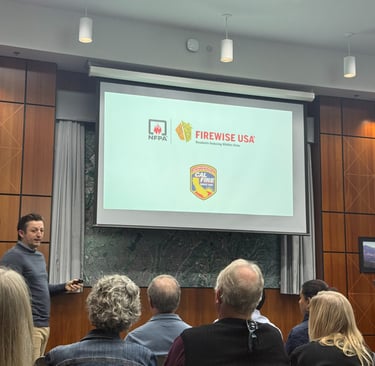
Navigating Wildfire Preparedness in California: Firewise USA, Ready for Wildfire, BEFIRESAFE.org, and Zone Zero Facts — A Homeowner’s Guide to the Options
If you live in Southern California wildfire country, What can I actually do to protect my home, my family, and my neighborhood without losing my mind (or my landscaping)?
The good news is you’re not starting from scratch. Four major resources dominate the conversation: Firewise USA, CAL FIRE’s Ready for Wildfire, BEFIRESAFE.org, and zonezerofacts.org. Each takes a different approach to the same core science — the Home Ignition Zone (HIZ) and the critical 0–5 foot “ember-resistant” area that determines whether your house survives when embers fly.
This guide breaks each one down in plain English, including how it started, who leads (or led) it, and their specific contributions to fire mitigation. It highlights the real-world upsides and downsides (the good and the bad), compares them head-to-head, and gives you a practical decision framework so you can choose what actually fits your community. By the end you’ll have a high-level map of the landscape — and one practical next step that many homeowners are now using to go further than any single program can take you alone.
1. Firewise USA: The Voluntary Community-Building Program
What it is
Firewise USA is a national, neighbor-led program run by the National Fire Protection Association (NFPA). It’s not a government mandate — it’s a recognition system for communities that commit to ongoing wildfire preparedness. You form a small volunteer committee, assess your neighborhood’s risks using NFPA 1144 standards, create a multi-year action plan, hold at least one annual education event, and invest the equivalent of one volunteer hour (or about $25.43) per home each year in mitigation work. In return, your neighborhood earns official “Firewise USA Site” status that you renew annually.
Origins and Leadership
The program traces its roots to the 1980s when the NFPA responded to severe property losses from brush, grass, and forest fires across the country — a clear “wake-up call” that the wildland-urban interface (WUI) problem extended far beyond California. After major fires in 1985–1986, NFPA partnered with federal and state agencies to develop the broader Firewise Communities Program, formalizing the term “Firewise” for smart landscaping and home-hardening practices. The Firewise Communities/USA Recognition Program officially launched in 2002 and is administered by the NFPA (founded in 1896 as a leader in national fire-safety standards).
Leadership comes from the NFPA’s Wildfire Division (established 2010). Michele Steinberg, Director of the Firewise USA® Program and Wildfire Division, has been a driving force for over two decades. A hazard mitigation specialist, Steinberg has dedicated her career to outreach, education, and scaling community resilience. She has served two consecutive terms on the Board of the International Association of Wildland Fire (IAWF), authored key research including the 2011 study “Firewise forever? Voluntary community participation and retention in Firewise programs,” and served on the Presidential Wildland Fire Mitigation Commission.
Her major contributions include leading national education campaigns that emphasize retrofits, ongoing maintenance, and neighbor collaboration; overseeing the Firewise grant program (such as the 2026 Wildfire Community Preparedness Day grants); conducting post-fire damage assessments; and advocating for policies that translate ember-science into practical, community-driven action. Under her guidance, Firewise has grown to more than 2,300 active sites nationwide (with over 1,100 in California alone), helping hundreds of thousands of homes reduce ignition risk through sustained, voluntary mitigation. In recent years she has highlighted engineering approaches to wildfire resilience and continues to drive high retention rates (99% in some recent periods) while emphasizing that 75% of community work focuses on homes and the immediate ignition zone.
Core technical focus
Everything revolves around the three-zone Home Ignition Zone:
- Immediate Zone (0–5 ft): Lean, clean, and green — non-combustible ground cover, no mulch or debris.
- Intermediate Zone (5–30 ft): Reduced fuels, pruned trees, mowed grass.
- Extended Zone (30–100+ ft): Thinned vegetation and broken fuel continuity.
Home hardening (Class A roofs, ember-resistant vents, etc.) is strongly encouraged. Communities also report vegetation removed (in cubic yards) and track investments.
The good
- Builds real neighbor cohesion and shared responsibility.
- Empowers residents instead of just telling them what to do.
- Opens doors to grants, insurance discounts in some states, and publicity.
- Proven local success stories: homes surviving fires because of cleared zones and hardened structures.
- Significant collective impact — millions of volunteer hours and dollars invested annually.
The bad
- Requires perpetual volunteer energy; momentum often fades without a strong leader.
- A major 2014 study found no statistical link between Firewise participation and lower firefighting costs.
- Individual costs for thinning or hardening can still hit homeowners hard.
- Free-riders and uneven participation are common complaints.
- Some residents grumble about the “never-ending” maintenance and the manicured look it can create.
Best for
HOAs or neighborhoods that want to organize themselves without heavy government involvement.
2. CAL FIRE’s Ready for Wildfire (readyforwildfire.org): The Official State Playbook
What it is
This is California’s flagship public-education website, run by CAL FIRE and the Office of the State Fire Marshal. It’s the “Ready, Set, Go!” hub — free checklists, videos, the firePLANNER tool, Spanish-language resources, and direct ties to legal defensible-space requirements under Public Resources Code 4291.
Origins and Leadership
CAL FIRE dates back nearly 140 years to the late 19th century when California first organized wildland fire protection. Ready for Wildfire evolved as the department’s modern public-facing preparedness campaign to translate science and law into actionable steps for residents. The widely used “Ready, Set, Go!” framework was co-created by Laura Blaul, retired Orange County Fire Authority (OCFA) Assistant Chief and Fire Marshal.
Blaul’s fire-mitigation contributions span more than 30 years in the fire service. At OCFA she built the Pre-Fire Management Section from the ground up, transforming compliance-based inspections into data-informed, proactive strategies that deliver measurable resilience. She co-developed “Ready, Set, Go!” — now a national model for wildfire preparedness used by agencies across the country — and emphasized shifting focus to prevention and community education.
Now serving as Senior Wildfire Fellow at the Insurance Institute for Business & Home Safety (IBHS), Blaul leads collaborative efforts in applied research, strategic partnerships, and community engagement to advance wildfire resilience. She chairs the Board of Directors for the California Fire Safe Council, where she works with public safety professionals, local governments, and residents to promote grant-funded mitigation and hands-on education. She also develops special-education workshops and fire-and-life-safety training, operating on the belief that resilience is rooted in science, strengthened by preparation, and sustained through community connection. Her work directly informs Ready for Wildfire’s strong emphasis on Zone 0 ember resistance and has shaped tools used by Southern California agencies.
Core technical focus
Three legally enforced zones plus a strong push for the emerging Zone 0:
- Zone 0 (0–5 ft): Zero combustibles — gravel, concrete, no plants or mulch.
- Zone 1 (5–30 ft): Lean, clean, green.
- Zone 2 (30–100 ft): Reduced fuels, mowed grass ≤4 inches.
Detailed home-hardening lists (Class A roofing, ⅛-inch mesh vents, non-combustible siding, etc.) are included. Non-compliance in State Responsibility Areas can bring fines up to $20,000. Data shows structures without compliant defensible space are six times more likely to burn.
The good
- Backed by hard data and proven effectiveness.
- Completely free, highly actionable, and localized with multilingual resources.
- Strong integration with Firewise (CAL FIRE is the state liaison).
- Covers evacuation planning, insurance strategies, and forest health.
The bad
- Feels bureaucratic and top-down to many homeowners.
- Strict Zone 0 rules have sparked complaints about “moonscape” yards, lost shade, urban heat, biodiversity loss, and high removal costs.
- Enforcement can be inconsistent or heavy-handed.
- Equity issues for low-income and renter households.
Best for
Anyone who wants the official, no-nonsense state standard — especially in high-hazard zones where inspections are routine.
3. BEFIRESAFE.org: The Practical, Neighbor-Driven Southern California Resource
What it is
A volunteer-run website created by Orange County residents for Orange County residents. It’s deliberately simple and solution-focused, with sections on “Save Your Home,” “Save Lives,” “Save Your Community,” and “Insurance Strategies.” Heavy emphasis on Orange County Fire Authority (OCFA) standards.
Origins and Leadership
BEFIRESAFE.org emerged in recent years as a purely grassroots response by Southern California homeowners facing escalating wildfire threats. It is operated by an anonymous “group of community volunteers” with no publicly named individual founders or leaders. The content draws heavily from OCFA guidelines — many shaped by Laura Blaul’s foundational work at OCFA (see above) — and reflects practical lessons from local HOAs and fire-prevention efforts in areas such as Rancho Santa Margarita. The volunteers’ contributions focus on translating official standards into easy-to-follow, neighbor-tested advice without adding bureaucracy or advocacy.
Core technical focus
Mirrors the same three-zone defensible-space model (strong Zone 0 emphasis) plus home-hardening checklists, evacuation tips (including Alert OC), pet safety, HOA coordination, and insurance strategies. It notes that Firewise recognition can sometimes support better insurance outcomes.
The good
- Hyper-local and easy to read — perfect for busy Southern California families.
- Holistic approach covering not just vegetation but evacuation, pets, and the insurance landscape.
- No-frills, solution-oriented tone that empowers without politics.
- Encourages actions that support Firewise or OCFA compliance.
The bad
- Limited depth — no dense scientific citations or detailed cost analyses.
- Geographically narrow; less useful outside Southern California.
- Does not address regulatory controversies in depth.
- Maintenance burden is implied but not fully explored.
Best for
Homeowners or HOAs in Orange County or nearby who want straightforward, neighbor-tested advice.
4. zonezerofacts.org: The Homeowner Advocacy and Pushback Site
What it is
An independent website that aggregates facts, official documents, and homeowner stories focused on California’s proposed (and now evolving) Zone 0 regulations. It serves as a clearinghouse for residents concerned about the aesthetic, financial, and livability impacts of strict 0–5 foot rules.
Origins and Leadership
The site was launched in the mid-2020s amid intense public debate over AB 3074, SB 504, and Governor Newsom’s Executive Order N-18-25 directing the Board of Forestry to finalize “ember-resistant” Zone 0 rules. It grew directly out of grassroots homeowner coalitions in areas like Brentwood, Pasadena, Altadena, and Los Angeles.
The site is prominently connected to Stephanie Landregan, FASLA — a nationally recognized landscape architect, educator, and advocate. Landregan served for years as Director of UCLA Extension’s Landscape Architecture and Horticulture & Gardening Programs, emphasizing community-based design and sustainable practices. She previously served as Chief Landscape Architect for the Mountains Recreation and Conservation Authority, gaining deep WUI planning experience.
Her fire-mitigation contributions include co-founding Altadena Green after the Eaton Fire, where she has led efforts to save hundreds of healthy trees through free arborist assessments, advocacy for hazardous-tree-removal waivers, training for removal crews, and public education on balancing fire safety with ecological and neighborhood values. She was appointed to the Blue Ribbon Commission on Climate Action and Fire Safe Recovery, providing guidance on Zone 0 implementation while advocating for policies that protect tree canopy, reduce urban heat, and maintain livability. Landregan regularly presents on fire-resilient design rules, tree ordinances, and low-impact development, helping homeowners and designers navigate compliance creatively without sacrificing beauty, biodiversity, or climate resilience.
Core technical focus
Explains proposed bans/exceptions (near-total vegetation removal in 0–5 ft with limited potted-plant allowances), potential impacts on costs, shade, wildlife, and property values, and opportunities for public comment. It contrasts with official messaging by highlighting scientific debates over healthy irrigated plants.
The good
- Raises legitimate homeowner burdens and secondary effects (urban heat, biodiversity).
- Aggregates official documents and helps residents engage in rulemaking.
- Brings landscape architecture expertise to the conversation.
The bad
- Advocacy tone that can feel one-sided or downplay some post-fire survival data.
- Focuses more on opposition than step-by-step compliance tools.
- Risks discouraging proactive mitigation if readers fixate only on pushback.
Best for
Homeowners who want to understand and potentially influence the regulatory process, especially where strict Zone 0 mandates are advancing.
Zone Zero Regulations Advocacy
Working with community groups across California, our goal is to prevent state government from adopting Zone Zero regulations that will inflict devastating environmental, ecological and economic harm on our community. If our efforts fail we will explore the legal options necessary to protect our unique canyon ecology and the quiet enjoyment of our homes without government overreach.
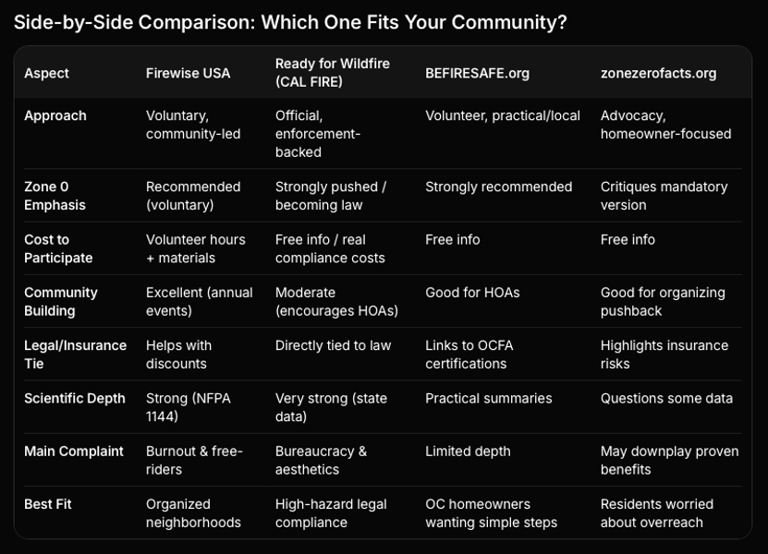
Side-by-Side Comparison: Which One Fits Your Community?
How to Choose What Works Best for Your Community
Ask yourself these four questions:
1. How much structure do you want? Love organizing neighbors? → Firewise USA. Prefer clear rules? → Ready for Wildfire.
2. Where do you live and what’s your risk level? → BEFIRESAFE.org. Facing new Zone 0 rules? → zonezerofacts.org for context.
3. Budget and volunteer capacity? Strong HOA? → Layer Firewise with BEFIRESAFE. Need legal compliance? → Prioritize CAL FIRE.
4. Voluntary vs. Mandatory mindset? Lead from the ground up? → Firewise + BEFIRESAFE. Need enforceable standards? → Ready for Wildfire.
Most successful communities layer them: Ready for Wildfire for the legal baseline, Firewise for momentum, BEFIRESAFE for local how-to’s, and zonezerofacts.org to stay informed on regulations.
Taking It to the Next Level: Boots-on-the-Ground Help
Understanding the options is the first step. Turning that knowledge into a safer, more resilient neighborhood — without the burnout, guesswork, or endless weekend work parties — is where many communities need extra support.
That’s exactly why fastfirenetwork.com exists. They’re the boots-on-the-ground solution that takes every program above a step further. Whether you’re starting a Firewise site, complying with CAL FIRE inspections, navigating Zone 0 rules, or simply want a professional plan that actually gets implemented, Fast Fire Network handles the heavy lifting — from complex risk assessments and reasonable vegetation management to community coordination and an ongoing maintenance mindset.
As their slogan puts it:
“We think about fire so you don’t have to.”
Here is the complete list of sources used to develop the article (including leader backgrounds, program origins, and technical details). All information is drawn from publicly available, credible websites and publications as of April 2026:
- NFPA Firewise USA official site and program documents (nfpa.org/firewise and getfirewise.org) — for program history, launch in 2002, structure, and statistics.
- Michele Steinberg’s professional profiles and NFPA Journal articles (LinkedIn, iawfonline.org, nfpa.org) — including her role as Wildfire Division Director, research (e.g., 2011 “Firewise forever?” study), Presidential Commission service, and contributions to education/grants.
- CAL FIRE Ready for Wildfire official resources (readyforwildfire.org and fire.ca.gov) — for program details, zones, and “Ready, Set, Go!” framework.
- Laura Blaul profiles (cafiresafecouncil.org, LinkedIn, IBHS references) — detailing her 30+ years at OCFA, creation of Pre-Fire Management Section, co-development of “Ready, Set, Go!”, and current role as Senior Wildfire Fellow at IBHS and Chair of California Fire Safe Council.
- BEFIRESAFE.org website (befiresafe.org) — for site content, volunteer-driven nature, and OCFA alignment.
- zonezerofacts.org and related presentations (Pasadena Heritage, Altadena Green, UCLA Extension) — for advocacy focus and regulatory context.
- Stephanie Landregan profiles and articles (LinkedIn, altadenagreen.org, landscapearchitect.com, Pasadena Heritage events) — covering her FASLA credentials, UCLA Extension directorship, Chief Landscape Architect role, co-founding of Altadena Green, tree-saving efforts (600+ trees), and Blue Ribbon Commission work.
- Additional historical context: Fire Engineering, FireRescue1, and USDA Forest Service references on Firewise origins in the 1980s.
List of Acronyms Used in the Article:
- HIZ — Home Ignition Zone
- WUI — Wildland-Urban Interface
- NFPA — National Fire Protection Association
- IAWF — International Association of Wildland Fire
- CAL FIRE — California Department of Forestry and Fire Protection
- OCFA — Orange County Fire Authority
- IBHS — Insurance Institute for Business & Home Safety
- FASLA — Fellow of the American Society of Landscape Architects
- LEED AP BD+C — Leadership in Energy and Environmental Design Accredited Professional, Building Design + Construction
- SRA — State Responsibility Area
- VHFHSZ — Very High Fire Hazard Severity Zone
- HOA — Homeowners Association
- ASLA — American Society of Landscape Architects
- PLA — Professional Landscape Architect (California license)
These sources ensure the article’s accuracy on program histories, leader contributions, and technical content. For the most current details, visit the primary organization websites directly.
This article may feature some AI-assisted content for clarity, consistency, and to help explore complex scientific concepts with greater depth and creative range.