Why N95 Masks Are Now Non-Negotiable
Beyond the Smoke: PBS NOVA Exposes How Wildfire Microbes Hitch a Ride—and Why N95 Masks Are Now Non-Negotiable
Beyond the Smoke: PBS NOVA Exposes How Wildfire Microbes Hitch a Ride—and Why N95 Masks Are Now Non-Negotiable
A dramatic image of orange flames licking through hazy smoke and charred vegetation recently lit up PBS NOVA’s social media. The caption was chilling: “Potentially infectious microorganisms can hitch a ride on wildfire smoke — and potentially harm people living nearby.”
This isn’t science fiction. It’s the latest installment of NOVA’s ongoing coverage (including the widely shared video “There’s Something Living in Wildfire Smoke”) highlighting a hidden threat that goes far beyond the usual particulate matter and toxic gases we associate with wildfire smoke. As wildfires grow more frequent and intense due to climate change, these living passengers in the smoke are forcing us to rethink personal protection—especially the critical role of high-quality masks.
What NOVA Revealed: Life in the Flames
Wildfire smoke isn’t just ash, charred plants, and nasty chemicals. It’s teeming with thousands of viable microorganisms—bacteria and fungi—that survive the inferno and travel hundreds or even thousands of miles.
Here’s how it works, according to the NOVA segment and the researchers it features:
- Not every part of a wildfire is blazing hot. On the microscopic scale, there are cool pockets of unburned air where bacteria and fungal spores can survive.
- These microbes latch onto bits of carbon (soot) or water vapor in the smoke plume.
- Once airborne, they ride the convection currents high into the atmosphere and get carried long distances by wind—well beyond the fire’s immediate perimeter.
The result? People living or working downwind—even hundreds of miles away—can inhale these potential pathogens without ever seeing flames.
NOVA highlights real-world evidence: A California study found a noticeable uptick in fungal infections (particularly systemic ones like coccidioidomycosis, or Valley fever) in hospitals within a 200-mile radius of major wildfires. Other research has linked wildfire smoke exposure to increased cases of invasive mold infections and aspergillosis. Researchers such as University of Idaho fire scientist Leda Kobziar (a pioneer in the emerging field of pyroaerobiology—the study of microbes in fire smoke) have shown that smoke can contain roughly four times more microbial cells than background air, with up to 78% of them still viable.
Climate change is supercharging the problem. U.S. wildfire seasons are now 105 days longer than in the 1970s, burn six times more acreage, and feature three times as many large fires. More intense blazes mean more smoke—and more opportunities for these microbial hitchhikers to spread.
The Double Threat: Particles + Pathogens
We’ve long known wildfire smoke is dangerous. The fine particulate matter (PM2.5) it carries inflames lungs, worsens asthma and COPD, triggers heart attacks, and even affects pregnancy outcomes. But the microbial component adds a sinister new layer:
- Smoke irritates and damages the respiratory lining, making it easier for any inhaled microbes to take hold.
- It can suppress immune function in the lungs, leaving people more vulnerable to infection.
- Fungi like Coccidioides (which causes Valley fever) are already spreading northward in California as drier, hotter conditions allow them to thrive—and fires aerosolize them efficiently.
In short, breathing wildfire smoke isn’t just like inhaling pollution. It can be like inhaling a biological weapon delivered by nature.
Why Masks—Specifically N95s or Better—Are Essential Protection
Staying indoors with windows closed and using HEPA air purifiers remains the #1 recommendation from the CDC and EPA. But when you must go outside (to walk the dog, check on elderly neighbors, or evacuate), a proper respirator is your best defense.
Here’s the evidence-based detail that makes N95s (or P100s) indispensable in this new microbial reality:
- Particle filtration that catches the carriers: NIOSH-approved N95 respirators filter out at least 95% of airborne particles 0.3 microns and larger. Most microbes in smoke don’t float freely—they hitchhike on larger soot particles and water droplets that N95s are proven to capture effectively. CDC and EPA guidance explicitly states that N95s remove the PM2.5 fraction of wildfire smoke with >95% efficiency.
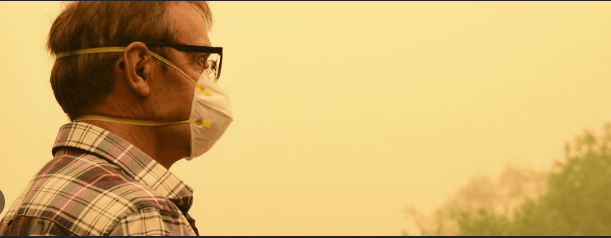
- Tight seal matters: Unlike loose cloth or surgical masks (which the CDC says do NOT protect against wildfire smoke), N95s must form a tight seal around your nose and mouth. When worn correctly, they dramatically reduce inhalation of both toxic particulates and the microbes riding them.
- Real-world validation: During recent major fire seasons, health agencies across California, Oregon, and Washington have repeatedly urged residents to wear N95s or KN95 equivalents when AQI hits unhealthy levels. Studies and guidance from the EPA confirm these masks provide meaningful protection against the full spectrum of smoke hazards, including bioaerosols.
If you can’t get an N95, a well-fitted KN95 is a strong runner-up (they often perform comparably in independent tests). Avoid dust masks, bandanas, or neck gaiters—they might feel better than nothing, but they let most smoke (and its passengers) through.
Pro tips for effective use:
- Check the fit every time—perform a seal check by inhaling sharply; the mask should collapse slightly against your face.
- Replace after 8 hours of continuous use or if it gets damp/soiled.
- Store extras in your go-bag, car, and workplace—wildfire smoke can arrive with little warning.
Looking Ahead: Preparedness in a Smokier World
PBS NOVA’s timely reminder comes as experts warn that the combination of longer fire seasons and microbial transport is expanding the “perimeter of biological impact” of every blaze. With more people expected to face repeated smoke exposure in places that never used to worry about it, personal protection can’t be an afterthought.
The good news? Simple, evidence-based steps like staying informed via AirNow.gov, keeping N95s on hand, and limiting outdoor time when the AQI is orange or worse can dramatically lower your risk—both from the chemical toxins and the living organisms in the smoke.
Next time you see those haunting images of wildfires and read the warning about “something living in the smoke,” don’t just scroll past. Grab your N95, seal the windows, and protect yourself. Because in today’s climate-altered world, the hidden dangers in the air demand visible action.
Stay safe, stay informed, and breathe easier—literally—by being prepared.
Sources drawn from PBS NOVA segments, CDC/EPA wildfire smoke guidance, The Lancet Planetary Health studies on post-fire fungal infections, and peer-reviewed pyroaerobiology research by Leda Kobziar and colleagues.
If you are looking for the best quality masks on the market, Head over to PACIFICFIRESUPPLY.COM for the best masks on the market!