The Inferno's Fury
Inside the 2018 Carr Fire Tornado That Tore Through Redding, California
The Inferno's Fury: Inside the 2018 Carr Fire Tornado That Tore Through Redding, California
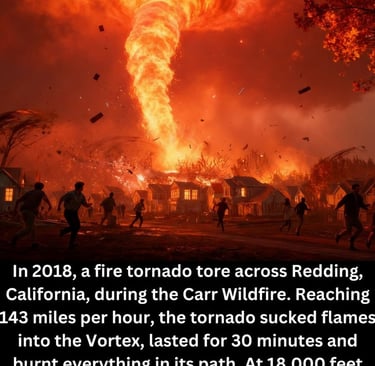
In the fading light of July 26, 2018, northwest Redding, California, looked like the end of the world. A colossal vortex of flame—glowing orange-red against a smoke-choked sky—spiraled thousands of feet into the air, sucking in trees, debris, and entire homes as it roared forward. Winds screamed at 143 miles per hour. Temperatures inside the column spiked beyond 2,700°F. For roughly 30 terrifying minutes, this fire tornado (often called a “firenado”) carved a path of total destruction through suburban neighborhoods, flipping vehicles like toys, uprooting century-old oaks, and claiming lives in one of the most violent wildfire events ever recorded in the United States.
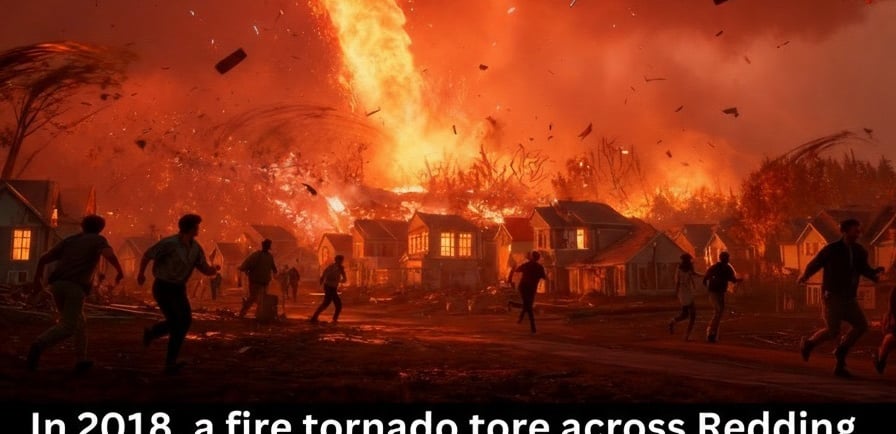
The image that opens this story captures the raw terror of that evening. Residents and firefighters watched in disbelief as the Carr Fire spawned something straight out of a disaster movie—a genuine tornado made of fire.
The Carr Fire: From Spark to Catastrophe
The nightmare began three days earlier, on July 23. Temperatures in Shasta County had hit a record-tying 111°F. A vehicle towing a trailer on Highway 299 near the Carr Powerhouse Road scraped metal against pavement, throwing sparks into bone-dry brush. The Carr Fire ignited in Whiskeytown National Recreation Area and exploded outward.
By July 26, the fire had already burned tens of thousands of acres. Extreme heat, low humidity, and a sharp pressure gradient between scorching inland air and cooler coastal winds created perfect conditions for explosive growth. The fire jumped the Sacramento River and marched toward Redding, a city of roughly 90,000 people nestled at the base of the Shasta-Trinity National Forest.
What no one anticipated was that the blaze would generate its own weather system.
The Birth of the Firenado
Around 5:30 p.m. on July 26, as the fire front pushed into the outskirts of Redding, something unprecedented began to form. A column of super-heated air rose rapidly, creating a powerful updraft. Then, a pyrocumulonimbus cloud—an ice-capped thunderstorm born from the fire itself—exploded upward. Satellite and radar data later showed this cloud tower doubling in height within 15 minutes, ultimately reaching nearly 39,000 feet.
That towering pyroCb acted like a giant vacuum, stretching and concentrating rotation at the surface. Antecedent wind shear along the fire perimeter provided the initial spin. The result: a narrow, violently rotating vortex that quickly widened to roughly 1,000 feet across at its base—wider than three football fields laid end-to-end.
National Weather Service meteorologists later estimated peak surface winds at 143 mph, firmly in EF3 tornado territory on the Enhanced Fujita scale. The vortex itself reached heights of approximately 18,000 feet, while the parent cloud system soared far higher. It wasn’t just a “fire whirl”—the common spinning columns of flame seen in many wildfires. This was a full-blown tornado-strength event driven by the fire’s own energy.
Radar captured a clear “tornado vortex signature.” Dashcam footage from fire engines showed trees bending horizontally and debris flying in tight circles. Flames licked the walls of the vortex like a living serpent.
150 Minutes of Hell: Eyewitness Accounts
The SF Chronicle’s groundbreaking reconstruction titled “150 Minutes of Hell” pieced together the chaos through dozens of interviews, radio transmissions, and 911 calls. Here are just a few of the stories that emerged:
Jeremy Stoke, 37
A Redding Fire Prevention Inspector who had cut short a family vacation to help. On Buenaventura Boulevard, Stoke was evacuating residents when the firenado struck. At 7:39 p.m. he radioed a desperate Mayday: “I need a water drop. I’m getting burned over.” His 5,000-pound Ford F-150 was flipped end-over-end. Stoke was killed instantly. A memorial now marks the exact black rectangle of scorched earth where his truck came to rest.
Don Smith, 81
A veteran private dozer operator. Trapped near the Buckeye Water Treatment Plant, Smith radioed his final words: “I’m cut off by the fire. I’m pushing down.” He died in his bulldozer.
Melody Bledsoe, 70, and her great-grandchildren
Inside their home on Quartz Hill Road, Melody soaked blankets to protect 5-year-old James “Junior” and 4-year-old Emily Roberts. In a heartbreaking 911 call, Junior begged his grandfather: “You gotta come in the front door, the back door is on fire.” The line went silent. The home collapsed; all three perished.
Bulldozer operator Don Andrews
Trapped alone, his dozer’s windows exploded. Glass shredded his face. He huddled under fire-resistant curtains, dialing 911 while flames roared around him like a freight train. “I don’t know how long I can last,” he told the dispatcher. Rescued later, he survived with serious burns.
Marin County firefighters Patrick Hoffman and Capt. Mark Burbank drove straight into the maelstrom, their engine cab hitting 200°F before they abandoned it and fled on foot to the river. Multiple dozer operators deployed fire shelters as rocks and embers pummeled their machines.
By the time the vortex dissipated around 8:00 p.m., it had jumped the Sacramento River, leveled entire blocks, and left a landscape that looked like it had been bombed.
The Science: Why This Firenado Was So Extreme
A November 2018 study published in Geophysical Research Letters explained the mechanics in detail. The key ingredient was the pyrocumulonimbus cloud. As moist air rose inside the fire plume and condensed, latent heat release intensified the updraft, stretching the spinning column of air like taffy and concentrating vorticity near the ground. This “pyrotornadogenesis” process shares similarities with non-mesocyclonic tornadoes but is uniquely powered by wildfire heat and moisture.
It was only the second documented fire tornado in modern records after the 2003 Canberra bushfires in Australia—and by far the most destructive in California history.
The Human and Economic Toll
The Carr Fire ultimately burned 229,651 acres, destroyed 1,604 structures, and damaged hundreds more. Eight people died in total. Insurance claims exceeded $1 billion. Whiskeytown National Recreation Area—97% burned—suffered the worst structural loss in National Park Service history.
The firenado alone was responsible for at least four of the fatalities and triggered the most intense structural destruction within the city limits.
Aftermath and Lessons for a Warming World
The Carr Fire was contained on September 1, 2018, after 41 days of battle. But its legacy endures.
Fire agencies across the West rewrote protocols for extreme fire behavior. Meteorologists now routinely monitor for pyrocumulonimbus development. Evacuation planning in wildland-urban interface zones has grown far more aggressive.
Climate scientists point to the event as a harbinger. Record heat, prolonged drought, and explosive fire weather are becoming the new normal. As one researcher noted after the fire: “This is what the future of wildfires looks like—except the acceleration hasn’t ended yet.”
Today, when you drive through the rebuilt neighborhoods of northwest Redding, you can still see subtle scars: newer homes standing beside mature trees that somehow survived, memorial plaques, and empty lots where families once lived. The land has healed in places, but the memory of that glowing orange vortex remains burned into the collective psyche of Northern California.
The 2018 Carr Fire tornado wasn’t just a wildfire event. It was a meteorological monster born from climate-amplified extremes—a warning written in flames across the California sky.
Sources for this article include official Cal Fire reports, National Weather Service damage surveys, the 2018 Geophysical Research Letters study on pyrotornadogenesis, and the San Francisco Chronicle’s exhaustive “150 Minutes of Hell” investigation. The opening image is an artist’s dramatic rendering of the actual event.