Invasive Beetles Ravaging So Cal
Invasive Beetles Ravaging Southern California's Oak Trees: A Looming Environmental Catastrophe
Invasive Beetles Ravaging Southern California's Oak Trees: A Looming Environmental Catastrophe
Welcome to the Fast Fire Network, your go-to source for in-depth coverage on environmental threats, wildfire risks, and ecosystem preservation in our home of Southern California. Today, we're diving into a pressing issue that's silently decimating one of California's most iconic landscapes: the invasion of destructive beetles targeting oak trees across Southern California. Sparked by a recent ABC7 Eyewitness News report, this story highlights how these tiny pests are not only killing hundreds of thousands of trees but also amplifying wildfire dangers in an already fire-prone region. Drawing from multiple sources, including news outlets, scientific reports, and expert insights, we'll explore the culprits, their impacts, and what can be done to fight back—now including the compounding threat of Sudden Oak Death (SOD), a devastating fungal-like disease that has long plagued California's oaks.
The Goldspotted Oak Borer: Southern California's Silent Killer
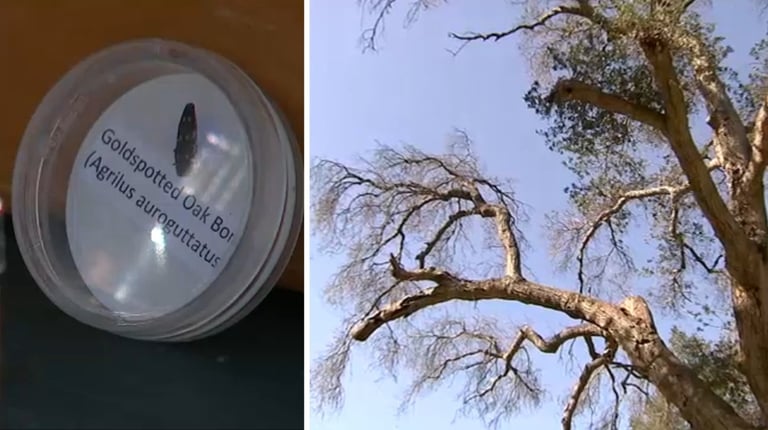
At the heart of this crisis is the Goldspotted Oak Borer (GSOB), scientifically known as Agrilus auroguttatus. This invasive beetle, native to southeastern Arizona and northern Mexico, was first detected in San Diego County in 2004, likely introduced through infested firewood. By 2008, it was confirmed as the cause of widespread oak mortality, particularly affecting coast live oak (*Quercus agrifolia*), canyon live oak (*Quercus chrysolepis*), and California black oak (*Quercus kelloggii*).
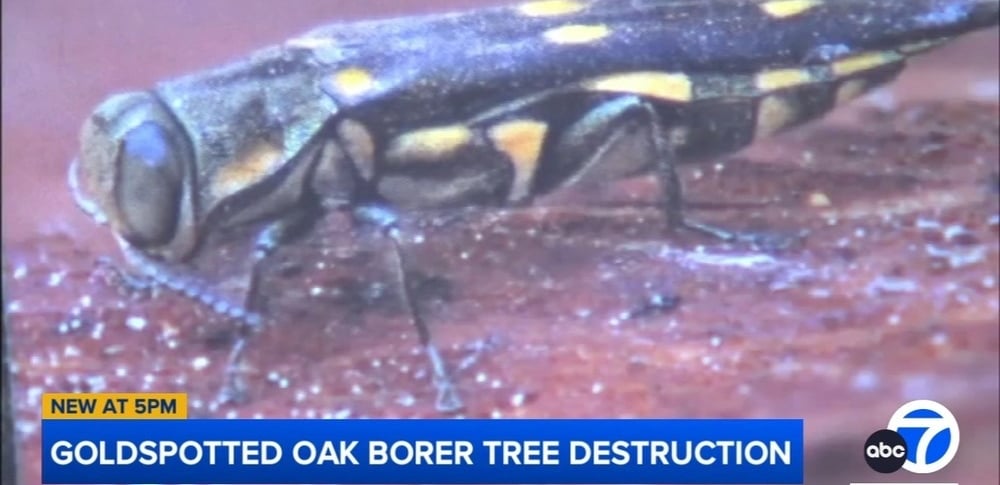
GSOB adults are slender, bullet-shaped beetles about 10 mm long, with a metallic green-black body adorned with six golden-yellow spots on their wing covers. Their life cycle is insidious: Adult females lay eggs in bark crevices, and the larvae burrow into the cambium layer—the tree's vital transport system for water and nutrients—creating serpentine galleries that disrupt flow and girdle the tree. This feeding activity can kill a healthy oak within a few years.
Symptoms of infestation are telltale: Thinning crowns with 60-70% leaf loss, D-shaped exit holes (about 2 mm wide), larval galleries under the bark, and reddish boring dust at the base of the tree. Infested trees often show blackened sap oozing from entry points. Once a tree reaches significant crown dieback, survival chances plummet to near zero.
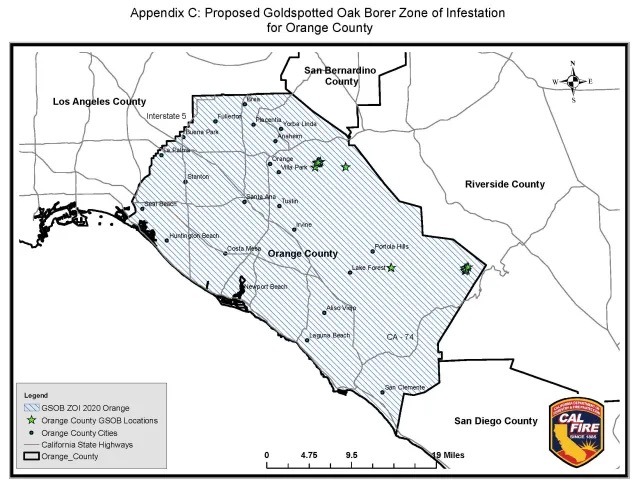
The beetle's spread has been rapid and human-aided, primarily via the movement of infested firewood. From its foothold in San Diego, GSOB has expanded to Riverside, Orange, Los Angeles, San Bernardino, and most recently, Ventura County in 2025. CAL FIRE estimates that GSOB has killed at least 200,000 oaks across the Southland, transforming vibrant woodlands into "boneyards" of dead trees. In areas like Simi Valley, entire hillsides of oaks have succumbed, leaving behind skeletal remnants that heighten fire risks.
Beyond GSOB: Other Invasive Beetles Joining the Assault
While GSOB grabs headlines, it's not alone. Southern California faces multiple invasive borers targeting oaks and other trees.
The Invasive Shot Hole Borers (ISHB), including the Polyphagous Shot Hole Borer (*Euwallacea whitfordiodendrus*) and Kuroshio Shot Hole Borer (*Euwallacea kuroshio*), are ambrosia beetles that carry a symbiotic fungus, Fusarium euwallacea, which clogs the tree's vascular system—a condition known as Fusarium dieback. These tiny beetles (about 2 mm long) attack over 60 host species, including coast live oak, California sycamore, and avocado. Symptoms include tiny entry holes (0.85 mm diameter), wet staining or powdery exudate on bark, frass "toothpicks," and dark discoloration in wood cross-sections. Damage leads to branch dieback, wilting foliage, and eventual tree death, threatening tens of thousands of trees in the region.
Further north but spreading southward, the Mediterranean Oak Borer (MOB, Xyleborus monographus) targets white oaks like valley oak (*Quercus lobata*) and blue oak (*Quercus douglasii*), often attacking stressed trees but capable of infesting healthy ones. Native to Europe, the Middle East, and North Africa, MOB was first detected in Napa Valley and has rapidly expanded to counties like Sonoma, Lake, Sacramento, and beyond. Females bore tunnels, introducing fungi that kill the tree over multiple generations. Symptoms include small entry holes, sawdust-like frass, and canopy decline. Without natural predators in California, MOB spreads via infested wood movement.
These borers compound threats from other pests like Sudden Oak Death, creating a perfect storm for oak ecosystems.
The Added Threat: Sudden Oak Death (SOD) – Phytophthora ramorum
Compounding the beetle invasions is Sudden Oak Death (SOD), caused by the invasive, fungus-like pathogen Phytophthora ramorum (an oomycete or water mold). First identified in California in the mid-1990s, SOD has killed millions of trees statewide, primarily in coastal regions from Monterey northward to Del Norte County and into southern Oregon. It primarily targets coast live oak, California black oak, canyon live oak, Shreve’s oak, and especially tanoak (*Notholithocarpus densiflorus*), with over a million trees dead since 1994.
Unlike the borers, which directly bore into trunks, P. ramorum spreads via spores from foliar hosts like California bay laurel (*Umbellularia californica*), whose leaves produce infectious spores during wet seasons. Oaks are "dead-end" or terminal hosts: they suffer lethal trunk cankers but rarely transmit the pathogen onward. The pathogen thrives in cool, moist coastal conditions, spreading through rain splash, wind, soil, water, and human movement of infected plants or soil.
Key symptoms include:
- Dark, oozing cankers on the trunk (often burgundy to black sap smelling like wine barrels).
- Discolored brown tissue under the bark with a black zone line.
- Rapid leaf browning (hence "sudden" death), though decline may precede this.
- Secondary invasions by bark/ambrosia beetles and decay fungi accelerating death.
In Southern California, SOD's impact is more limited than in the north, but it affects similar oak species (e.g., coast live oak) and overlaps with beetle ranges. Recent reports (2025 California Oak Mortality Task Force updates) show persistent spread at infestation perimeters, with a more virulent NA2 strain detected in Bay Area locations, potentially favored by warmer, drier conditions under climate change. This creates synergies: SOD-weakened trees become more susceptible to beetle attacks, and vice versa, hastening mortality and increasing dead fuel loads.
Ecological, Economic, and Fire Risks: Why This Matters
Oaks are keystone species in Southern California's landscapes, providing habitat for wildlife, shading streams, and stabilizing soil. Their loss disrupts biodiversity—acorns feed animals, branches shelter birds, and roots prevent erosion. Economically, dead trees reduce property values, increase removal costs, and hurt industries like tourism and agriculture (e.g., avocados affected by ISHB).
Most alarmingly, these invasions exacerbate wildfire dangers. Dead oaks become dry fuel, turning forests into tinderboxes. In fire-prone areas like Ventura and San Bernardino counties, this heightens risks for communities. As Kim Corella of CAL FIRE noted, oaks act as "ember catchers" during fires; without them, flames spread faster. The combination of beetle-killed trees and SOD mortality amplifies this threat across broader regions.
Fighting Back: Prevention and Management Strategies
Controlling these threats is challenging, but prevention is key. The primary vector for beetles is human movement of infested wood—don't transport firewood more than 5-10 miles or across county lines. Buy local, certified heat-treated firewood (140°F for one hour) to kill hidden larvae.
For SOD, avoid moving potentially infected plant material, soil, or water from infested areas. Clean tools, vehicles, and shoes after visiting affected sites.
For management:
- Monitoring and Reporting: Participate in citizen science like the GSOB Blitz or SOD Blitz, where volunteers survey trees and sample bay laurel leaves. Report sightings to your county agricultural commissioner or via apps like iNaturalist.
- Tree Care: Keep trees healthy with proper watering, mulching, and avoiding injuries to reduce susceptibility.
- Removal and Disposal: Prune dead branches, remove heavily infested trees, and chip wood to <1 inch pieces or solarize under clear tarps for months.
- Chemical Controls: Systemic insecticides are largely ineffective for GSOB and ISHB; preventive sprays (e.g., carbaryl) may help but require professional application. For SOD, phosphonate treatments like Agri-Fos® (injected or trunk-sprayed) offer preventive protection for high-value trees, though not a cure—apply in fall/spring and booster as needed. Reduce nearby bay laurels to lower spore sources.
Organizations like UC ANR, CAL FIRE, USDA, and the California Oak Mortality Task Force lead research into biological controls and resistant trees, but none are widely available yet.
What You Can Do: Join the Effort
As residents of Southern California witness this unfold, individual actions matter. Inspect your oaks for signs of infestation or SOD (bleeding cankers, leaf spots on bays), avoid moving wood or plant material, and support local conservation groups. Spread awareness: Share stories like the ABC7 report to educate others. Together, we can slow the spread and preserve these vital trees for future generations.
The battle against invasive beetles and pathogens like Phytophthora ramorum is far from over, but with vigilance and community action, we can mitigate the damage. Stay tuned to Fast Fire Network for updates on this and other environmental stories.
References
- [Goldspotted Oak Borer beetles killed 200,000 oak trees in SoCal; experts share prevention tips](https://abc7.com/post/goldspotted-oak-borer-beetles-known-gsobs-responsible-killing-least-200000-trees-southern-california/18657768) - ABC7 Eyewitness News
- [Invasive beetles are killing oak trees; UC ANR community scientists are fighting back](https://ucanr.edu/blog/green-blog/article/invasive-beetles-are-killing-oak-trees-uc-anr-community-scientists-are) - UC ANR Green Blog
- [Sudden Oak Death](https://cisr.ucr.edu/invasive-species/sudden-oak-death) - Center for Invasive Species Research, UC Riverside
- [California Oak Mortality Task Force Reports (2025)](https://www.suddenoakdeath.org/) - Various monthly reports, e.g., August 2025
- [Sudden Oak Death in the Loma Prieta Chapter](https://www.sierraclub.org/loma-prieta/blog/2025/09/sudden-oak-death-loma-prieta-chapter) - Sierra Club
- [Citizen Scientists Discover More Virulent Form of Sudden Oak Death](https://vcresearch.berkeley.edu/news/citizen-scientists-discover-more-virulent-form-sudden-oak-death) - UC Berkeley
- [Sudden Oak Death Pest Note](https://ipm.ucanr.edu/home-and-landscape/sudden-oak-death/pest-notes) - UC IPM
- [ABC7 Eyewitness News X Post on Invasive Beetles](https://x.com/ABC7/status/2029013963841651157) - @ABC7