Fluid Dynamics in Wildland Fire Suppression
Fluid Dynamics in Wildland Fire Suppression: The Role of Pumping Water from Pools
Fluid Dynamics in Wildland Fire Suppression: The Role of Pumping Water from Pools
Wildland fires, often fueled by dry vegetation, high winds, and extreme temperatures, pose a significant threat to ecosystems, communities, and infrastructure. In the United States, these fires have become more frequent and intense due to climate change, with millions of acres burned annually. Suppression efforts rely heavily on water as a primary extinguishing agent, but in remote or suburban areas where hydrants are scarce or overwhelmed, alternative sources like swimming pools become critical. Pumping water from pools exemplifies the practical application of fluid dynamics in firefighting, blending engineering principles with on-the-ground tactics to combat flames.
Fluid dynamics, a branch of physics that studies the behavior of fluids in motion, is central to understanding how water is sourced, pumped, and delivered to fire lines. In wildland fire scenarios, this involves not just aerial drops or ground hoses but also the intricate process of drafting water from static sources like pools. This method gained prominence in regions like California, where urban-wildland interfaces (WUIs) see homes with pools serving as impromptu reservoirs during evacuations. Firefighters or homeowners use portable pumps to extract thousands of gallons, creating defensive perimeters or supplying engines.
However, pumping water is far from simple. It involves overcoming physical challenges like pressure drops, turbulence, and friction losses, all governed by fluid dynamics. This article delves into these principles, explores their application in pumping from pools, and highlights the complexities that make this a high-stakes operation. By examining real-world examples and advancements, we uncover how fluid dynamics enhances wildfire suppression strategies, ultimately saving lives and property.
Fundamentals of Fluid Dynamics in Firefighting
At its core, fluid dynamics describes how liquids and gases move under various forces, including gravity, pressure, and viscosity. In wildland fire suppression, water acts as an incompressible fluid, meaning its density remains constant under typical pressures. Key equations govern its behavior, such as the continuity equation, which states that the mass flow rate through a system is constant: \( A_1 v_1 = A_2 v_2 \), where \( A \) is cross-sectional area and \( v \) is velocity. This principle ensures that water speeding up in narrower hoses maintains the same volume flow rate, crucial for delivering consistent streams to nozzles.
Bernoulli's principle further explains pressure dynamics: \( P + \frac{1}{2} \rho v^2 + \rho g h = constant \), where \( P \) is pressure, \( \rho \) is density, \( v \) is velocity, \( g \) is gravity, and \( h \) is height. In pumping systems, this reveals trade-offs— increasing velocity reduces pressure, which can lead to inefficiencies if not managed. For instance, in fire hoses, high velocity creates turbulence, characterized by the Reynolds number (\( Re = \frac{\rho v D}{\mu} \), with \( D \) as diameter and \( \mu \) as viscosity). When \( Re > 4000 \), flow becomes turbulent, increasing energy losses due to internal friction.
In wildland contexts, these principles apply to both fire spread and suppression. Fires generate convective currents and updrafts, modeled using computational fluid dynamics (CFD) to predict plume behavior and optimize retardant drops. For ground operations, pumps must overcome atmospheric pressure to draft water, relying on vacuum creation for suction lift. Centrifugal pumps, common in firefighting, use impellers to impart kinetic energy to water, converting it to pressure via the volute. Efficiency here depends on hydraulic design—impeller shape affects flow rates, with typical outputs ranging from 500 to 1,500 gallons per minute (GPM) at 150 psi.
Viscosity plays a subtle role; water's low viscosity aids flow, but additives like foam increase it, altering dynamics for better adhesion to vegetation. Elevation changes introduce head losses: for every 10 feet of height, pressure drops by about 4.3 psi, requiring pumps to compensate. These basics underscore why pumping from pools isn't just hooking up a hose—it's a calculated interplay of physics to ensure water reaches the fire effectively.
Pumping Water from Pools: A Vital Tactic in Wildland Firefighting
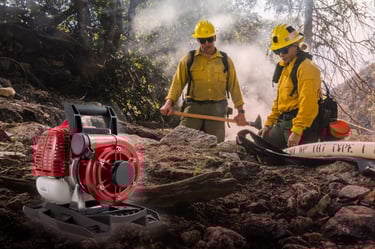
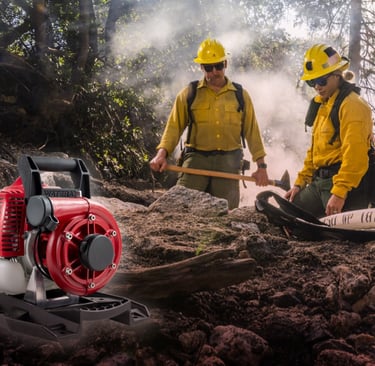
In areas prone to wildland fires, such as California's hillsides, swimming pools hold an average of 20,000-30,000 gallons—more than many fire tenders. This makes them invaluable when municipal water systems fail due to high demand or damage. Firefighters draft from pools using portable pumps, like gasoline-powered centrifugal units, to supply hoses or create sprinkler systems for home defense.
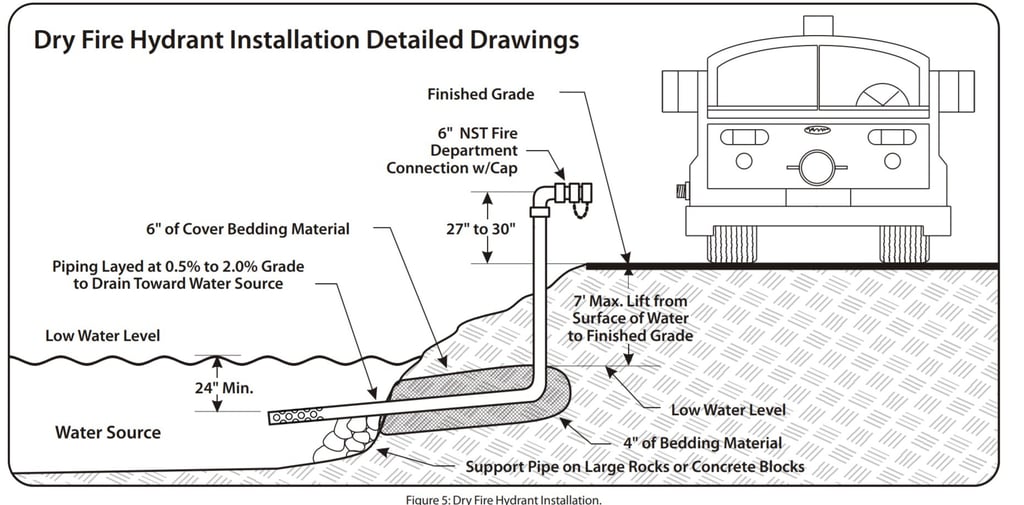
The setup typically involves a suction hose with a strainer submerged in the pool, connected to the pump's inlet. The pump primes by evacuating air, allowing atmospheric pressure (14.7 psi at sea level) to push water up the hose—a maximum theoretical lift of 33.9 feet, though practical limits are 20-25 feet due to losses. Output hoses then deliver water at pressures up to 200 psi, enabling streams to reach 50-100 feet.
Fluid dynamics optimizes this: Larger diameter suction hoses (e.g., 2.5-4 inches) reduce velocity and friction, per the Darcy-Weisbach equation for head loss (\( h_f = f \frac{L v^2}{2 g D} \), where \( f \) is friction factor, \( L \) length). Homeowners often use systems like the Portable Fire Pump Cart, which draws from pools to wet vegetation, providing a "fighting chance" before professional help arrives. In the 2025 Palisades Fire, crews resorted to pools when hydrants ran dry, using portable pumps to sustain operations.
Advanced systems integrate automation, running on generators to operate during power outages, spraying water via roof-mounted sprinklers. This tactic not only conserves municipal resources but leverages fluid principles to maximize suppression efficiency in WUI zones.
The Complex Nature of Pumping Water: Challenges and Considerations
Pumping water in firefighting is inherently complex, amplified in wildland scenarios by environmental variables. Drafting from pools introduces unique hurdles: debris like leaves or chemicals can clog strainers, reducing flow and risking cavitation—vapor bubbles collapsing in the pump, causing damage. Chlorinated water may corrode equipment over time, though it's generally usable.
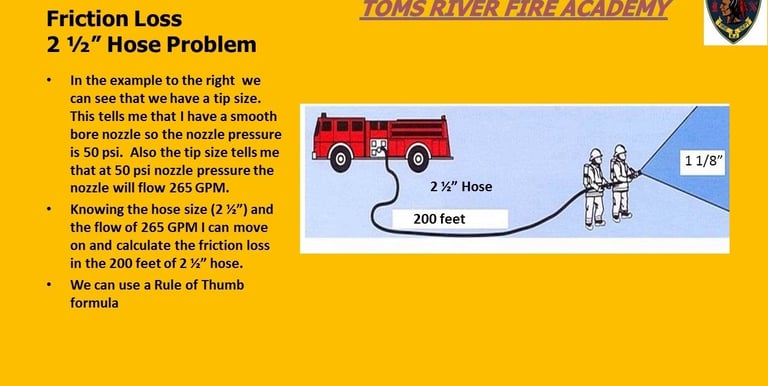
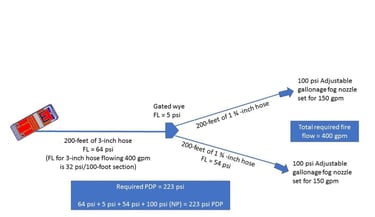
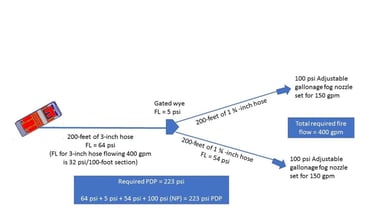
Suction lift is a major challenge; pools in hilly terrain often require lifts exceeding 10 feet, where each foot adds 0.43 psi vacuum demand. Exceeding limits leads to pump failure, as air enters the system. Friction losses in hoses compound this: For a 200-foot 1.75-inch line flowing 150 GPM, loss might be 54 psi, requiring the pump to output 223 psi total (including nozzle pressure and elevation).
Turbulence exacerbates losses; high Reynolds numbers in long hoses create eddies, dissipating energy. Elevation in wildland areas adds head: Pumping uphill demands extra pressure, with steep slopes limiting effective range. Water quality issues, like sedimentation post-fire, further complicate drafting.
Operational complexities include priming time—up to minutes in dirty water—and maintaining uninterrupted supply. In large fires, multiple pumps in relay increase complexity, with each adding potential failure points like hose kinks or air leaks. Power outages necessitate generators, adding logistical burdens.
CFD simulations help mitigate these by modeling flow paths, but on-scene, firefighters rely on rules-of-thumb: Start with 150 psi pump discharge, adjust based on feedback. Despite advancements, the interplay of variables makes pumping a blend of science and art, where miscalculations can hinder suppression.
Real-World Applications and Innovations
Case studies illustrate these dynamics. During the 2019 Australian bushfires, helicopters drafted from pools when dams were inaccessible, applying Bernoulli's for efficient drops. In California's 2025 fires, families used pool pumps to save homes, draining 60,000 gallons over days to soak perimeters.
Innovations include high-efficiency impellers boosting hydraulic efficiency to 85%, reducing fuel use. Water ejectors, using Venturi effect, draft from shallow sources without moving parts. CFD models now simulate entire suppression scenarios, optimizing pump placements.
Portable systems like Brushfire Battle integrate fluid-optimized nozzles for better reach, while research at Montana State explores drop dynamics for ground parallels. These advances address complexities, enhancing resilience in fire-prone areas.
Conclusion
Fluid dynamics underpins the effectiveness of pumping water from pools in wildland fire suppression, from basic flow equations to tackling real-world complexities like cavitation and friction. As fires intensify, understanding these principles empowers better strategies, turning backyard pools into lifesaving assets. Future innovations in pumps and modeling promise even greater efficiency, but success hinges on preparation and respect for the fluid's unforgiving nature. In the fight against wildland fires, mastering water's movement is key to victory.