Don't Get Burned: Choosing the Right Outdoor Wildfire Suppression System in Fire-Prone Areas
Poor engineering, substandard installations, exaggerated marketing claims, and a complete lack of U.S. wildfire-specific performance standards have left some homeowners with expensive setups that fail when it matters most
Don't Get Burned: Choosing the Right Outdoor Wildfire Suppression System in Fire-Prone Areas
As wildfires grow more intense and frequent in the wildland-urban interface (WUI), homeowners in California, Colorado, and other high-risk zones are understandably turning to active defense options like exterior rooftop sprinklers, perimeter misters, automated systems, and spray-on gels or coatings. These promise to wet surfaces, quench embers, and buy critical time against radiant heat and flame contact.
But here's the hard truth many discover too late: not all systems—or the companies selling them—are created equal. Poor engineering, substandard installations, exaggerated marketing claims, and a complete lack of U.S. wildfire-specific performance standards have left some homeowners with expensive setups that fail when it matters most—or worse, create false confidence that leads to greater losses.
At Fast Fire Network (fastfirenetwork.com), our mission is simple: empower and protect communities by connecting homeowners with credible, credentialed wildfire protection solutions. We cut through the hype so you don't make fear-driven decisions that put your home and family at risk. This article draws on real case studies, expert analyses, and regulatory findings to help you ask the right questions, spot red flags, and hire the right people—before you sign on the dotted line.
The Standards Vacuum: Why "It Worked in Testing" Isn't Enough
One of the biggest red flags in the outdoor wildfire suppression industry is the near-total absence of standardized testing or minimum performance requirements in the United States.
According to the Insurance Institute for Business & Home Safety (IBHS) 2024 White Paper on External Sprinkler Systems for Wildfire Defense, "there are currently no standardized test methods for assessing the effectiveness of external sprinkler systems nor is there a minimum performance requirement for these systems." Many products simply repurpose landscape irrigation components—plastic pipes, heads with moving parts—that are prone to heat-induced failure, clogging, or malfunction in high-wind wildfire conditions. (Australia's AS 5414-2012 standard, by contrast, has prohibited moving parts since 2012 to minimize breakdowns.)
Real-world factors like Santa Ana winds can cause up to 40% of sprayed water to drift uselessly downwind and 20% to evaporate before it even hits the target. Systems often depend on municipal water and power that fail exactly when wildfires hit hardest—think hydrant dry-outs during the 2025 Palisades Fire or widespread outages in major California events.
Bottom line for homeowners: If a company can't show you third-party, wildfire-specific performance data under realistic high-intensity conditions (not just lab or irrigation tests), walk away. Passive hardening—Class A roofs, defensible space, ember-resistant vents—remains the evidence-based foundation. Active systems should only supplement it, never replace it.
Misleading Claims That Prey on Fear
Marketing materials often flood websites with bold numbers: "96% survival rate," "protects up to 3,000°F for 5+ years," or "NASA-developed technology." These claims sound reassuring—until independent scrutiny reveals otherwise.
A prime example is the 2019 lawsuit against Sun FireDefense (Sunseeker Enterprises) and owner James Moseley. Los Angeles City Attorney Mike Feuer and Santa Barbara County District Attorney Joyce Dudley sued the company for false advertising of its SPF 3000 Clear Spray coating. The product claimed it could protect homes from wildfires, heat, and embers up to 3,000°F; extinguish flames; last 5+ years after one application; and was eco-friendly and non-toxic. Prosecutors said independent tests showed it did none of those things reliably and contained hazardous chemicals. A judge issued an injunction blocking the ads, and the case settled with a multimillion-dollar judgment.
This isn't an isolated incident. Many companies hype unproven "guaranteed" performance while burying disclaimers about wind, infrastructure failure, or the need for perfect maintenance. As a homeowner, demand verifiable, independent data—not slick videos or testimonials.
"Firefighter-Founded" Doesn't Always Mean Wildland Expertise
Another common sales tactic: "Founded by firefighters" or "wildland firefighter-owned and operated." It builds instant trust, especially when emotions run high after a nearby fire.
But credentials matter. Take Frontline Wildfire Defense (now operating in 12 Western states). Founder/CEO Harry Statter holds a BS in landscape ecology from the University of Michigan and started Firewise Landscapes Inc. in 2001, focusing on landscaping and defensible space. His background is in forestry, applied ecology, and environmental studies—not an extensive career fighting high-intensity wildfires on the fireline.
Other firms market themselves as "firefighter-owned" with vague references to "firsthand experience" but provide few details on years in wildland incident command, large-scale suppression ops, or relevant certifications beyond entry-level. Short-term or structural firefighting experience doesn't automatically translate to expertise in designing systems that survive ember storms, 60+ mph winds, and total infrastructure collapse.
Pro tip from Fast Fire Network: Ask pointed questions about the founder's or lead engineer's actual wildland career length, specific incidents commanded, and engineering credentials. True experts welcome scrutiny; hype artists deflect.
Lessons from Real Fires: When Systems Fail (or Succeed)
History shows the stakes. During the 2007 Ham Lake Fire in Minnesota, properly installed and maintained exterior sprinkler systems achieved ~98% structure survival rates among threatened homes. However, failed or poorly maintained systems performed worse than homes with no sprinklers at all (only ~11% survival vs. ~37% unprotected). The difference? Inadequate water supply, activation timing, maintenance lapses, and design shortcuts.
(NOTE: These failures didn't just mean "no protection" — in some cases, the presence of a visible but non-functional system may have created false confidence, leading owners to skip other critical steps like defensible space clearance or evacuation planning. Failed systems also sometimes interfered with firefighting efforts.)
Similar patterns emerge in California fires: systems relying on city water failed when hydrants ran dry; cheap components clogged or melted; and uneven coverage left ember-vulnerable spots exposed.
These aren't theoretical risks. They translate directly to residential home loss—and heartbreak—when homeowners trusted the first flashy offer.
How to Hire the Right People: Your Actionable Checklist
Don't let fear push you into the first "firefighter-founded" pitch or the cheapest bid. Here's how to protect yourself and your community:
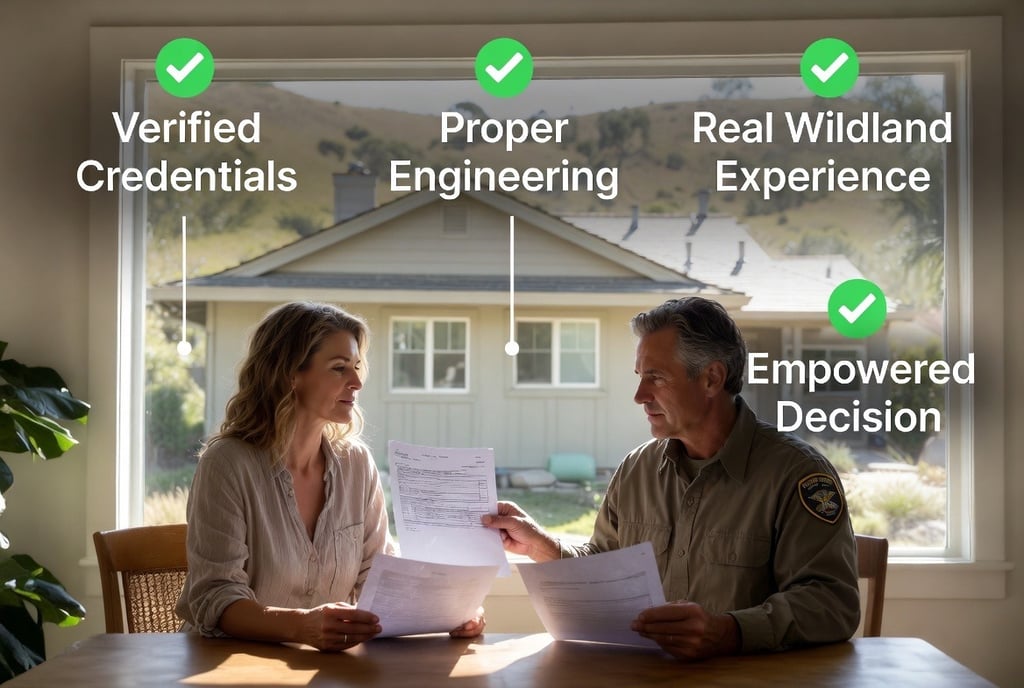
1. Demand Real Credentials — Insist on installers/engineers with documented extensive wildland firefighting careers (not just marketing spin), plus proper licensing, insurance, and references from recent WUI projects.
2. Verify Standards (or Lack Thereof) — Ask explicitly about compliance with any wildfire-specific testing. If they cite "engineering judgment" only, probe deeper. Look for companies that openly discuss limitations and integrate passive + active strategies.
3. Get Multiple Quotes and Independent Reviews — Compare at least three bids. Check for transparent maintenance plans, backup power/water options, and post-install support. Read independent analyses (IBHS, NFPA) rather than company testimonials.
4. Red Flags to Avoid:
- Emotion-driven sales ("Your neighbors are all installing this—don't wait until it's too late!").
- Unrealistic survival percentages without third-party data.
- No discussion of wind, evaporation, or infrastructure risks.
- Pressure to skip defensible space or passive hardening.
5. Think Long-Term — The best systems include ongoing service, annual inspections, and community coordination. Fast Fire Network exists to connect you with exactly these trusted partners.
Final Word: Empowerment Over Emotion
Your home is worth more than a hasty decision born of fear. By doing your homework, you not only protect your property—you help raise the bar for the entire industry and safeguard your neighbors.
At Fast Fire Network, we're building a community of informed homeowners who refuse to settle for subpar work. Whether you need training, equipment service, private protection support, or vetted installers in the Southern California area, we're here to help you prepare and defend.
Visit fastfirenetwork.com today to connect with credentialed solutions and join the movement protecting our communities—one informed decision at a time.
Sources
- Insurance Institute for Business & Home Safety (IBHS). External Sprinkler Systems for Wildfire Defense: White Paper. November 2024. https://ibhs1.wpenginepowered.com/wp-content/uploads/Final-2024-Sprinklers-White-Paper.pdf
- IBHS. "External Sprinklers for Wildfire Defense." https://ibhs.org/wildfire/external-sprinklers-for-wildfire-defense/
- CBS Los Angeles. "Marina Del Rey Company Sued For False Advertising." August 5, 2019. https://www.cbsnews.com/losangeles/news/marina-del-rey-company-sued-for-false-advertising/
- Los Angeles Times. "Company's wildfire protection spray doesn't work as advertised, prosecutors say." August 6, 2019. https://www.latimes.com/california/story/2019-08-05/wildfire-protection-spray-advertising-claims
- Johnson, J.F., et al. External Sprinkler Systems and Defensible Space: Lessons Learned from the Ham Lake Fire and the Gunflint Trail. University of Minnesota, 2008. https://waterwinger.ca/wp-content/uploads/2019/04/Minnesota-Wildfire-Sprinkler-Report-08.pdf
- Frontline Wildfire Defense. "About Us" and founder background. https://www.frontlinewildfire.com/about-frontline-wildfire-defense/
- LinkedIn profile and interviews with Harry Statter confirming landscape ecology background.
- Fast Fire Network official site. https://fastfirenetwork.com/
This article is for educational purposes and reflects publicly available information as of April 2026. Always consult licensed professionals and current local codes for your specific property.